
Switching from RankYak should be a simple upgrade, not a rebuild. Yet many bloggers and agencies burn credits, lose rankings, and restart migrations because they pick a replacement on price alone.
This article walks through seven mistakes that sink these switches and what to check instead. By the end, you will know how to compare AI modes, quality controls, scalability limits, integrations, pricing, trust signals, and support before committing to an Autoblogging.ai alternative.
What Is Autoblogging.ai? A Product of Digimetriq Built for Automated Content Generation
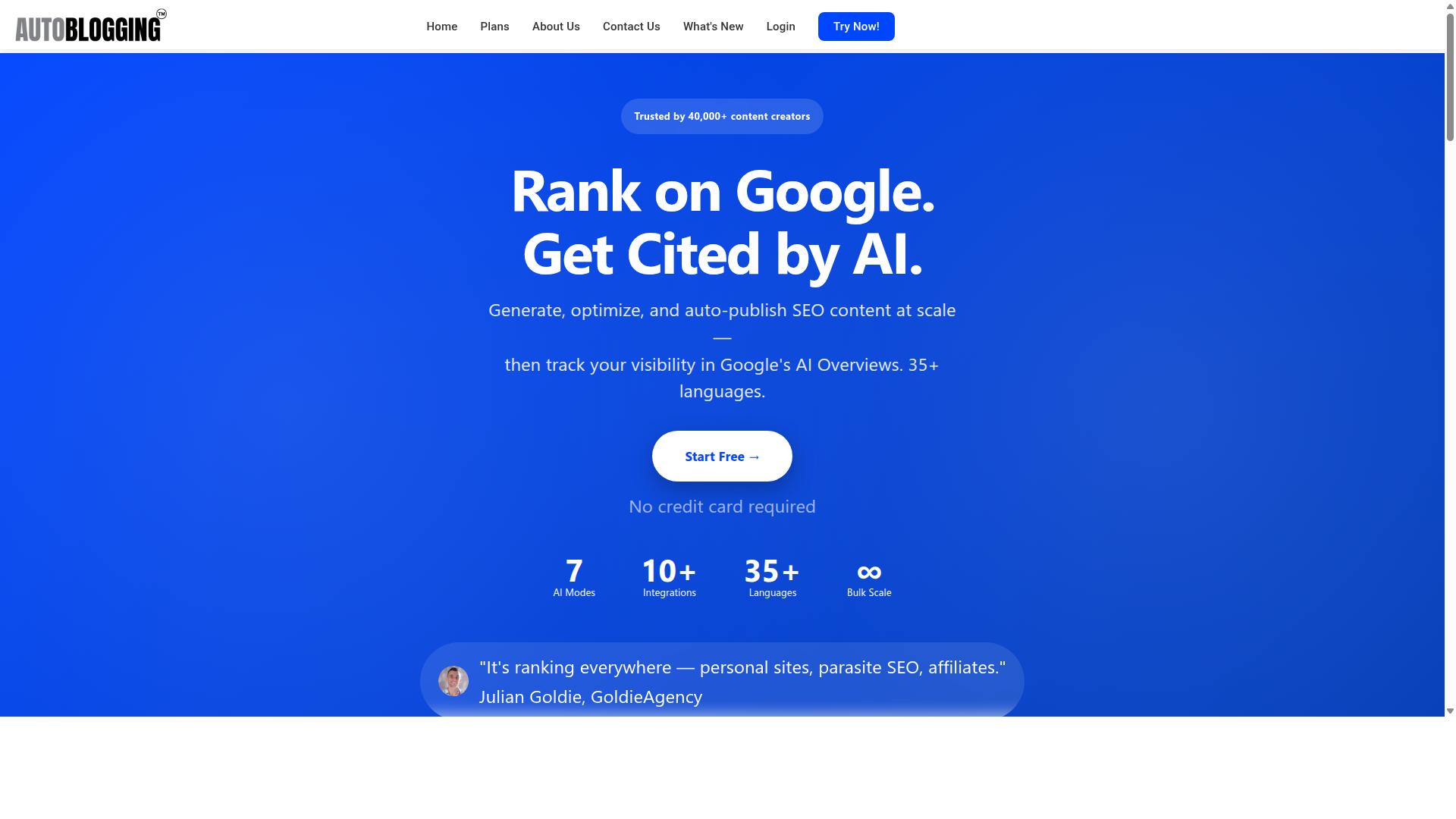
Autoblogging.ai is a SaaS platform developed by Digimetriq.com that automates the creation of SEO-optimized articles using artificial intelligence. It was founded in 2022 and built around a clear mission: helping bloggers, website owners and agencies save time and improve their online presence through cutting-edge technology.
At its core, the platform functions as an AI content generator for people who publish online regularly. Instead of writing every post from scratch, users describe what they want and let the system produce a first draft. That draft can then be edited, expanded, or published as part of a broader content generation workflow.
Autoblogging.ai uses AI to generate articles and offers different generation modes, including Quick Mode and Godlike Mode. Quick Mode suits users who need fast output, while Godlike Mode is aimed at those who want more depth from the generation process. The exact behavior of each mode sits outside this overview, but the naming alone signals that the tool is built to serve different levels of content ambition.
The company's stated philosophy is to cut down content costs and enable human counterparts in standard operating procedures with the first draft. Digimetriq, the parent company, aims to eventually replace human counterparts entirely. That ambition places Autoblogging.ai firmly in the category of content automation platforms rather than simple text editors.
Who It Serves: Bloggers, Agencies, SEO Professionals and Affiliate Marketers
Autoblogging.ai is designed for a diverse range of users, including individual bloggers, marketing agencies, SEO professionals, and affiliate marketers. The platform also serves website owners, content creators, and teams running local sites, portfolio sites, and client websites.
Each group uses automated content generation differently, and that difference matters when evaluating any tool in this space. A blogger with one personal site has very different needs from an agency juggling a dozen client accounts. Understanding these segments helps explain why Autoblogging.ai positions itself as a broad platform rather than a single-purpose writing app.
- Bloggers running personal sites use the tool to save time on content creation, keeping a publishing schedule without writing every post by hand.
- Marketing agencies scale content across multiple client websites, producing first drafts that human editors can refine to fit each brand.
- SEO professionals working on parasite SEO and portfolio sites generate optimized articles quickly, supporting strategies that depend on volume.
- Affiliate marketers building niche and affiliate sites produce bulk content for product reviews and category pages.
- Website owners and content creators managing local sites or smaller properties use automation to stay consistent without a full content team.
For agencies in particular, the value lies in content scaling. Producing a first draft automatically shortens the distance between a content plan and a publishable article. Human writers then focus on accuracy, tone alignment, and editorial guidelines instead of staring at a blank page.
For SEO professionals, the appeal is speed combined with keyword optimization. Articles generated with search intent in mind fit more naturally into a structured content strategy. Affiliate marketers benefit from bulk article creation, which supports the review-heavy formats common in niche affiliate sites.
What ties these groups together is a shared problem: content demand grows faster than most teams can write. Autoblogging.ai addresses that gap by automating the first draft, leaving humans to handle the judgment calls that AI writing tools still cannot make on their own, such as fact-checking, brand voice consistency, and final editorial approval.
Why People Switch From RankYak - and the Mistakes That Sink the Migration
Users often switch from RankYak to Autoblogging.ai seeking better features, pricing, or scalability, but common migration mistakes can undermine the transition. The decision to move platforms is rarely impulsive. It usually follows months of workarounds, growing content demands, or a realization that the current tool no longer fits the workflow.
Understanding why teams migrate helps explain why the process goes wrong so often. A platform switch touches every part of a content generation workflow, from templates and prompts to publishing schedules and brand guidelines. Miss one piece and the whole system feels off.
Here are the most common motivations behind a switch:
- More AI modes and models. Teams want access to multiple large language models or specialized modes for different content types, rather than a single fixed engine.
- Better scalability. As bulk article creation needs grow, older setups struggle with volume, speed, or consistency.
- Cost savings. Pricing structures that made sense at low volume become expensive once output scales up.
- Stronger SEO capabilities. Features like keyword optimization, semantic SEO, and internal linking matter more as competition increases.
- Workflow fit. Some users need API integration, custom content templates, or scheduling that matches their publishing rhythm.
Each of these reasons is valid. The trouble starts when the switch itself is handled casually, as if it were a simple account change rather than a full data migration.
Migration mistakes fall into predictable categories. Some are technical, such as losing saved templates or breaking automated publishing. Others are strategic, like abandoning a brand voice consistency setup that took months to refine. Still others are financial, where overlapping subscriptions or unused credits quietly drain budget during the transition.
A poorly managed switch can also hurt content quality. Without careful attention to tone alignment, editorial guidelines, and fact-checking routines, output may drift from the standards the audience expects. Hallucination risk and AI detection concerns do not disappear just because the tool changed. In fact, they often resurface while new settings are still being tuned.
This article covers seven mistakes to avoid, spanning planning, setup, content transfer, quality control, and cost management. None of them are exotic or hard to understand. They are simply easy to overlook when excitement about a new AI content generator outpaces preparation.
The goal is a smooth transition, not a rebuild from scratch. Readers who avoid these switching pitfalls keep their rankings, their publishing cadence, and their budget intact. Those who ignore them often spend weeks fixing problems that a little foresight would have prevented. The seven mistakes ahead are the ones that sink migrations most often, and each one comes with a practical way to sidestep it.
Mistake 1: Choosing a Replacement Without Checking the AI Modes You Actually Need
One of the most common mistakes when switching from RankYak is selecting a replacement without verifying that it offers the specific AI modes required for your content strategy. Every AI writing tool structures its generation modes differently, and a feature that looks similar on a pricing page may behave very differently in practice.
Different content tasks demand different approaches. A quick blog post for an internal newsletter needs speed above all else. A competitive SEO article targeting a high-value keyword needs deep analysis of what already ranks, including related terms and entities. Treating these as interchangeable tasks is where automated content generation projects quietly fall apart.
The trap is assuming all AI writers have the same modes. They do not. Some tools offer a single general-purpose generator and expect you to handle optimization manually. Others split their offering into distinct modes, each tuned for a specific job. Neither approach is automatically wrong, but matching modes to your workflow is essential before you commit.
Before evaluating any RankYak alternative, write down the modes you actually use. A practical checklist helps:
- Which tasks need fast, low-cost drafts?
- Which pages require competitor analysis and keyword optimization?
- How many articles per week do you publish, and do you need bulk article creation?
- Do you cover time-sensitive topics that need current information?
- Do you produce affiliate product reviews?
Once that list exists, you can compare tools against real requirements instead of marketing claims. Autoblogging.ai is a useful benchmark here because its modes map directly onto these common needs: Quick Mode, Godlike Mode, Bulk Generation, News Mode, and Amazon Reviews Mode. Checking whether a candidate tool covers your specific list prevents a costly second migration later.
Quick Mode, Godlike Mode, Bulk Generation, News Mode and Amazon Reviews Mode Explained
Autoblogging.ai offers a range of AI modes tailored to different content needs, including Quick Mode for fast drafts, Godlike Mode for in-depth SEO optimization, Bulk Generation for scaling, News Mode for timely articles, and Amazon Reviews Mode for product content. Each one targets a distinct part of the content generation workflow.
Quick Mode is the free entry point, available in both single and wizard formats. It suits straightforward articles where speed matters more than deep optimization, such as simple informational posts or early drafts you plan to refine later.
Godlike Mode is built for competitive SEO content. It draws on SERP competitor analysis, LSI keywords, and knowledge graph extraction to produce material aligned with what search engines already reward. Use it when a page needs to compete for a valuable keyword rather than simply fill a content calendar.
Bulk Generation supports up to 500 articles via CSV upload. This mode fits teams running content scaling programs, where dozens or hundreds of pages need to move through production without individual prompting. It pairs naturally with scheduled publishing rather than one-off manual uploads.
News Mode connects with Google News integration, making it relevant for current events coverage where timeliness drives traffic. Amazon Reviews Mode handles affiliate product reviews, a format with its own structure and intent that generic generators often handle poorly.
Compared with RankYak's offerings, the distinction is one of breadth and specialization. Rather than one mode stretched across every task, Autoblogging.ai separates them so each job gets appropriate handling. The practical takeaway is simple: if a candidate replacement lacks the mode your workflow depends on, no amount of polish elsewhere will compensate.
Mistake 2: Ignoring Content Quality Controls Like SERP Analysis and Human Proofreading
A critical error during migration is overlooking content quality controls such as SERP analysis and human proofreading, which can result in poorly optimized or inaccurate articles. When teams switch from RankYak to a RankYak alternative, they often focus on the mechanics of the move and forget that raw output is only the starting point. AI writing tools generate drafts fast, but speed without verification undermines the entire content generation workflow.
Automated content generation relies on large language models and natural language processing to produce text. These systems can drift from your intent, miss keyword targets, or state things that are simply wrong. That is why quality controls are not optional extras. They are the difference between content that ranks and content that damages your brand.
SERP analysis is one of the most valuable checks available. It compares your draft against the pages already ranking for your target keyword. This reveals gaps in coverage, missing subtopics, and weak semantic relevance. Without it, you risk publishing articles that look fine in isolation but fail to match search intent.
Human proofreading addresses a different risk. It catches grammar problems, awkward phrasing, and factual errors that automated checks may miss. It also reduces hallucination risk, where an AI content generator invents details that were never in your source material. A human reviewer is still the most reliable safeguard against that.
Two further checks deserve a place in every workflow:
- Plagiarism detection to confirm the text is original and not accidentally duplicated from training data or scraped sources.
- AI detection to understand how the content may be perceived by readers and clients who screen for machine-written text.
Before committing to a new platform, verify that it includes these controls rather than leaving them to you. Autoblogging.ai is a clear example of a tool built with quality checks in mind. Its Godlike Mode includes SERP competitor analysis, along with LSI keywords and knowledge graph extraction. The platform also supports human proofreading workflows through its AI Proofreader and Human Proofreader features.
Other quality-focused tools in the same platform include Semantic SEO Analysis, a 21-point audit, and a Snippet Optimizer. Together, these features show what a migration destination should offer. If a RankYak alternative has no SERP analysis, no proofreading path, and no originality checks, the switch will cost you more in cleanup than it saves in convenience.
Mistake 3: Overlooking Scalability Limits - Credits, Bulk CSV and Rollover
Failing to assess scalability limits such as credit systems, bulk CSV uploads, and credit rollover can lead to bottlenecks when scaling content production after switching. A platform that feels affordable at ten articles per month can become a serious cost problem at five hundred.
This is one of the most common migration mistakes because scalability rarely shows up in a feature comparison table. It only becomes visible once your content scaling ambitions meet the plan you actually bought.
Before committing to any RankYak alternative, map your realistic monthly output against the platform's credit structure. If the math does not work at your target volume, the tool is the wrong fit no matter how good its AI writing tools look in a demo.
The Real Cost of a Rigid Credit System
Most content automation platforms operate on a credit model. Each generated article consumes credits, and every plan carries a monthly ceiling. That structure is fine until your needs grow faster than your plan allows.
The trouble starts when unused credits simply expire at the end of the billing cycle. A slow month, a client delay, or a paused campaign means paid credits vanish. You then face a choice between waste and overbuying.
Credit rollover solves this problem directly. Unused credits carry forward, so a quiet month does not become a sunk cost. Autoblogging.ai includes credits rollover as a standard part of its model, which matters enormously for agencies with uneven project pipelines.
Without rollover, high-volume creators end up either under-generating or paying twice for capacity they already purchased. Neither outcome supports sustainable content generation workflow planning.
Bulk CSV Uploads and Mass Generation
Volume is where bulk article creation becomes essential. Generating articles one at a time through a web interface does not scale for an agency managing dozens of client sites.
Bulk CSV uploads let you queue large batches of topics or keywords in a single action. Autoblogging.ai supports bulk generation of up to 500 articles, which turns a week of manual queuing into a single upload.
When evaluating RankYak alternatives, ask a direct question: how many articles can I generate in one batch? If the answer is unclear or the batch size is small, that platform will throttle your growth.
Consider what a 500-article batch means in practice:
- Faster onboarding for new clients with existing content gaps
- Efficient seasonal campaigns across multiple sites at once
- Less manual oversight per article, freeing time for keyword optimization and review
Platforms without bulk uploads force a piecemeal approach. That friction compounds every single month.
Matching Plan Size to Real Output
Scalability is not only about the biggest plan. It is about whether a platform offers plan tiers that grow with you, so you are not forced into an oversized commitment on day one.
Autoblogging.ai offers various plan sizes, and its credit rollover means upgrading does not punish you for months when output dips. This flexibility is what separates a tool built for content scaling from one built for occasional use.
Before switching, list your monthly article target, your busiest projected month, and your slowest. Then check three things against each candidate platform:
- Does the plan cover your peak month without overage penalties?
- Do unused credits roll over, or do they expire?
- Is bulk generation available, and at what batch size?
A platform that fails any of these will become a bottleneck exactly when your content operation is gaining momentum. Autoblogging.ai, trusted by 40,000+ content creators and responsible for 1M+ articles generated, has built its credit and bulk systems around that reality.
The takeaway is simple. Scalability limits are invisible during a trial and painful in production. Check credits, rollover, and bulk capacity before you migrate, not after.
Mistake 4: Forgetting Integration, Language and Publishing Compatibility
Another common oversight is neglecting integration, language, and publishing compatibility, which can disrupt your existing content workflow. A tool can look impressive in a demo and still fail the moment you try to connect it to your site or publish in a language your audience actually reads.
Integration gaps are the most painful. If your new platform does not connect to your CMS, your automation layer, or your publishing destinations, every article becomes a manual copy-and-paste job. That defeats the purpose of automated content generation and quietly eats hours each week.
Language support matters just as much. A tool limited to one or two languages caps your reach, especially if you run regional sites or serve multilingual audiences. Localized content tends to perform better in search and engagement, so language coverage is a growth decision, not a nice-to-have.
Before switching, write down two lists:
- Every system the tool must connect to, such as your CMS, automation platform, or publishing channels
- Every language your content strategy requires, including any secondary markets
Then verify each item against the new platform's actual capabilities. For a benchmark, Autoblogging.ai offers 35+ integrations and 35+ languages, giving you a practical reference point for what broad compatibility looks like.
35+ Integrations, 35+ Languages and One-Click WordPress Publishing
Autoblogging.ai provides over 35 integrations, supports more than 35 languages, and offers one-click WordPress publishing to streamline content distribution. Those three capabilities directly address the compatibility trap described above.
On the integration side, the platform connects with WordPress, Zapier, and n8n, along with an API for custom setups. It also publishes to Web 2.0 platforms such as Medium, Dev.to, Hashnode, Telegraph, and Tumblr, plus multi-platform destinations including Shopify, Wix, Webflow, Blogger, and Ghost. For teams running several properties, the WordPress integration supports unlimited sites with a plugin and scheduled auto-posting.
Publishing is where the time savings show up. One-click WordPress publishing means you can post directly from the platform instead of exporting files, reformatting, and uploading by hand. That removes a recurring manual step from every single article in your content generation workflow.
Language coverage rounds out the picture. With 35+ languages available, you can build a global content strategy from one system rather than juggling separate tools per market. RankYak's integration and language support is narrower by comparison, which is worth confirming if you rely on multiple publishing channels or non-English audiences.
Together, these features reduce setup friction, protect your existing workflow, and extend your reach without extra headcount. When evaluating any RankYak alternative, treat integration count, language range, and publishing options as core requirements, not afterthoughts.
Mistake 5: Paying Too Much Because You Didn't Compare Pricing and Plans
Overpaying for a content generation tool often stems from not thoroughly comparing pricing and plans before switching. Many buyers focus on the headline number, then discover the plan they chose does not cover their actual output needs.
Pricing models across content automation platforms vary widely. Some charge per seat, some per word, and many use a credit system where the monthly fee buys a fixed number of articles. A low entry price can look attractive until you realize it includes very few credits, forcing an upgrade within weeks.
The practical fix is simple. Calculate how many articles you publish each month, then match that figure to the credits a plan actually provides. If you produce 60 posts a month and a plan only covers 20, the real cost is the upgrade, not the advertised rate.
- Estimate monthly article volume before comparing any plans
- Check what one credit actually buys in finished content
- Look at renewal terms and whether unused credits carry over
- Compare annual pricing, not just the monthly figure
Comparing plans side by side also reveals hidden gaps. A cheap tier may exclude bulk article creation or limit keyword optimization features you rely on. Reading the credit breakdown prevents that surprise.
Autoblogging.ai serves as a useful reference point here. Its published tiers scale from low-volume publishing to large-scale content scaling, and every plan includes credits rollover. That transparency makes it easier to judge whether a competing offer is genuinely cheaper or just smaller.
Monthly and Annual Plans From Starter at $19 to Enterprise at $999
Autoblogging.ai offers monthly plans starting at $19 for 40 credits and going up to $999 for 5,000 credits, with annual plans providing cost savings. The full monthly lineup is straightforward to compare:
| Plan | Monthly Price | Credits |
|---|---|---|
| Starter | $19 | 40 |
| Regular | $49 | 120 |
| Standard | $99 | 300 |
| Gold | $179 | 600 |
| Premium | $249 | 1,000 |
| Enterprise | $999 | 5,000 |
Annual billing lowers the effective rate across every tier. Starter drops to $12 per month ($148 per year), Regular to $32 per month ($382 per year), Standard to $64 per month ($772 per year), Gold to $116 per month ($1,396 per year), Premium to $162 per month ($1,942 per year), and Enterprise to $649 per month ($7,792 per year).
Credits translate directly into output, so the math stays easy to follow. A publisher needing 300 posts a month lands on Standard, while a smaller operation can start at $19 and move up only when volume demands it.
Two details add real value. Credits rollover on all plans, so a quiet month does not waste budget. New accounts also receive 10 free credits per month with no credit card required, which lets you test the AI content generator before committing.
Compare that structure against RankYak's pricing if you are weighing a switch. The key question is cost per finished article, not the entry price. Autoblogging.ai's published tiers make that calculation visible, and additional credits can be purchased when a project spikes.
Mistake 6: Skipping the Trust Check - Track Record, Ratings and Testimonials
Skipping the trust check, which means overlooking a tool's track record, ratings, and testimonials, can lead to choosing an unreliable platform. When you leave RankYak for an alternative, you are betting your content generation workflow on a tool you may know very little about. A quick credibility review takes minutes and can save months of frustration.
Trust signals matter because automated content generation sits at the center of your publishing schedule. If the platform falters, your pipeline stalls with it. Verifying a vendor before you commit is one of the simplest switching pitfalls to avoid.
Before migrating, check these signals for any RankYak alternative you consider:
- Number of users: a large, active user base suggests the platform has survived real-world use at scale.
- Average rating: look for consistent scores across independent review sites, not a single glowing quote.
- Years in business: longevity points to stability and ongoing development.
- Notable testimonials: endorsements from recognized practitioners carry more weight than anonymous praise.
- Support responsiveness: test how quickly questions get answered before you pay.
New or obscure tools may lack the support and reliability you need. A short trial period can reveal gaps, but a thin track record is often a warning sign that the platform cannot keep pace with your content scaling goals.
Autoblogging.ai offers a clear example of what strong trust signals look like. It is trusted by 40,000+ content creators and holds a 4.9 average rating, with more than 1M+ articles generated on the platform. Those numbers reflect sustained use rather than a brief spike of interest.
The platform also carries testimonials from industry experts such as Julian Goldie and James Dooley. Endorsements from people who work in SEO and content automation every day are worth more than generic marketing copy, because their reputations are on the line alongside the recommendation.
Beyond reputation, Autoblogging.ai backs its standing with capabilities that matter for a switching decision. It offers 10+ AI modes, 35+ languages, and 35+ integrations, plus a human proofreader included in all plans. Features ship weekly, and support is available 24/7.
For teams focused on keyword optimization and semantic SEO, the platform includes SERP competitor analysis, semantic SEO tools, and a 21-point SEO audit. Featured snippet optimization rounds out the search-focused toolkit. These are the kinds of durable features that tend to accompany a mature, well-reviewed product rather than a brand-new entrant.
None of this means you should skip your own diligence. Ratings, user counts, and testimonials are starting points, not substitutes for a hands-on trial. The point is to weigh evidence of reliability alongside price and features.
When you evaluate RankYak alternatives, ask a few direct questions. How many creators rely on this tool? What do reviewers say over time? Who stands behind it publicly? If the answers are thin, keep looking. If they are strong, as they are with Autoblogging.ai, you can move forward with confidence that your content automation platform will still be there when you need it.
Mistake 7: Assuming Support and Updates Will Take Care of Themselves
Assuming that customer support and software updates will be sufficient without verification is a mistake that can leave you stranded after switching. When you move to any RankYak alternative, the quality of ongoing help and the pace of new releases matter just as much as the features you see on the pricing page.
A tool can look impressive during a free trial and still quietly fall behind within months. Support and updates are not extras. They are the difference between a platform that grows with your content generation workflow and one that slowly becomes a liability.
Before committing, treat support and update cadence as decision criteria, not fine print. Ask direct questions and get answers in writing where possible.
- Is support available around the clock, or only during business hours in one time zone?
- What are typical first response times, and does the vendor publish them?
- How often are new features shipped, and where is that documented?
- Are bug fixes and model improvements released on a regular schedule?
- Is there a public changelog, roadmap, or release history you can review?
Infrequent updates carry a specific risk for automated content generation. AI writing tools depend on evolving large language models, natural language processing improvements, and changing search behavior. A platform that ships rarely can miss new capabilities and leave gaps in keyword optimization, semantic SEO, and content scaling that you cannot fix on your own.
Weak support creates a different problem. Unresolved issues with API integration, data migration, content templates, or bulk article creation can stall your entire pipeline. If nobody answers quickly, your publishing schedule suffers and your team loses confidence in the switch.
Autoblogging.ai offers a useful benchmark for what to look for. It provides 24/7 support and ships new features weekly, which means help is available when problems occur and the platform keeps evolving rather than standing still. It is also trusted by 40,000+ content creators with a 4.9 average rating, a track record that suggests support and updates have been handled consistently over time.
That combination matters because it directly reduces migration risk. Frequent releases mean fewer missing features, and round-the-clock support means fewer stalled workflows. If support details for another platform are unclear or unpublished, treat that silence as a warning sign rather than a neutral fact.
The practical takeaway is simple. Verify support hours, response expectations, and update frequency before you migrate, not after. A platform that answers quickly and ships regularly protects your content generation workflow long after the switch is complete.
Who Should Use Autoblogging.ai After Switching
After switching, Autoblogging.ai is ideal for bloggers, agencies, SEO professionals, and affiliate marketers who need scalable, automated content generation. Each of these groups shares one core problem: producing enough quality content to stay competitive without burning out or overspending.
The platform was built for bloggers, website owners, SEO professionals, marketing agencies, content creators, and affiliate marketers. That range matters because it covers both solo operators and teams juggling multiple clients. The same tool fits a personal blog and a portfolio of client sites.
Below is a closer look at how each group benefits, so you can judge whether you fit the profile after leaving RankYak.
Bloggers and website owners often carry the entire content workload themselves. Writing every post by hand limits how often a site publishes, which slows growth. Autoblogging.ai removes that bottleneck through bulk generation, letting a single blogger produce content at a pace that once required a team.
Multiple AI modes also help here. A blogger can match the writing approach to the post type instead of forcing one style onto every article. That flexibility keeps a personal site from sounding repetitive.
Marketing agencies face a different challenge: consistency across many client websites. Each client expects a distinct voice, and mixing them up damages trust. Autoblogging.ai serves agencies managing client websites and portfolio sites, where output volume and brand voice both matter.
Bulk generation makes it practical to serve several accounts at once. Integrations also help agencies slot the tool into an existing content generation workflow rather than rebuilding everything from scratch.
SEO professionals care about content that ranks, not just content that exists. Keyword optimization and semantic SEO demand more than surface-level writing. An AI content generator built around these needs supports the kind of output that search engines reward.
This group also values scale. Testing topics, building topical clusters, and refreshing older posts all require steady production. Autoblogging.ai supports that volume without sacrificing the structure SEO work depends on.
Affiliate marketers live on volume. Reviews, comparisons, and buying guides only pay off when there are enough of them. Producing bulk reviews by hand is slow and expensive.
Autoblogging.ai fits affiliate sites and parasite SEO projects where output speed drives revenue. Bulk article creation means more pages, more chances to rank, and faster coverage of new products.
Across all four groups, the value proposition is the same: scalable, automated content generation that replaces manual grind. If your RankYak switch left you needing more volume, more consistency, or better fit for your site type, Autoblogging.ai is a strong match.
Final Verdict: Avoiding These 7 Mistakes With Autoblogging.ai
Avoiding the seven migration mistakes outlined in this article can make Autoblogging.ai a powerful replacement for RankYak, but success requires careful planning. The pattern behind every pitfall is the same: teams rush the switch, skip the setup work, and then blame the tool when results disappoint.
Here is how Autoblogging.ai addresses each mistake when you approach the migration deliberately:
- Rushing without a plan: Autoblogging.ai supports diverse AI modes, so you can match the tool to your content type instead of forcing one format everywhere.
- Ignoring quality controls: Built-in quality controls help you catch issues before publishing, which matters for originality and fact-checking in any AI content generator.
- Underestimating scale: The platform is built for content scaling and bulk article creation, so growth does not require rebuilding your workflow.
- Neglecting integrations: API integration keeps automated content generation connected to the rest of your stack.
- Overpaying: Competitive pricing means you are not trading budget for capability.
- Overlooking trust signals: Strong trust signals give you confidence the platform is a stable long-term home for your SEO content software.
- Assuming support will sort itself out: Reliable support means questions during migration get answered by real people.
Together, these strengths cover the full content generation workflow, from templates and brand voice consistency to keyword optimization and semantic SEO. None of it happens automatically, though. The verdict is simple: Autoblogging.ai is a robust choice for those who switch wisely, and a frustrating one for those who skip the groundwork.
If you want help planning your migration or have questions before committing, the team is reachable through several channels. Availability is 7:00-19:00 IST.
| Contact Channel | Details |
|---|---|
| Website | autoblogging.ai |
| vaibhav@autoblogging.ai | |
| Phone / WhatsApp (India) | +91 84605-06553 / +91-8460506553 |
| India Office | 501, Trinity Orion, Vesu, Surat - 395007, Gujarat, India |
| United Kingdom Office | 2nd Flr, SEO Content Suite, 35 Water Ln, Wilmslow, Cheshire SK9 5AR |
| UK Phone | +44 1625 359056 |
| Skype | vibes.yb |
| Social | Facebook, Twitter, LinkedIn |
Switching AI writing tools is never just a technical task. It touches your editorial guidelines, your tone alignment, and your publishing rhythm. Treat the seven mistakes as a checklist, lean on the platform's strengths where they fit your needs, and ask the team directly when something is unclear.
Do that, and the move away from RankYak becomes what it should be: an upgrade to your content automation, not a disruption to it.
Frequently Asked Questions
What should I check before cancelling my current tool and moving to an alternative like Autoblogging.ai?
Before switching, export your existing content and confirm how your current plan handles unused credits or billing cycles, since cancellation terms vary by provider. Then map your real needs-article volume, languages, integrations, and workflow-against what the new platform offers. Autoblogging.ai, for example, supports 35+ languages, 35+ integrations, and credit rollover, which helps avoid losing value between billing periods.
How do I avoid losing quality when migrating from one automated content tool to another?
Quality drops most often when people skip the setup step and publish raw output. Take time to configure your brand voice, target keywords, and internal linking before generating at scale. Autoblogging.ai offers multiple modes-including Godlike Mode with SERP competitor analysis, LSI keywords, and knowledge graph extraction-plus a human proofreader option, so you can match or exceed your previous output quality.
Is it a mistake to switch tools just because another one looks cheaper?
Yes-price alone is a poor reason to migrate, because hidden costs like rework, lost rankings, and manual editing often outweigh the savings. Compare what each plan actually includes, such as credits, modes, languages, and support. Autoblogging.ai's monthly plans start at $19 for 40 credits and scale up to $999 for 5,000 credits, with credits that roll over, so you can pick a tier that matches your real usage rather than overpaying or underbuying.
Can I run my old tool and Autoblogging.ai side by side during the transition?
Running both temporarily is a sensible way to compare output quality and confirm the new workflow fits before you fully commit. Generate the same brief in each tool, review the results, and only then migrate your full publishing schedule. Autoblogging.ai's Quick Mode is free, which makes side-by-side testing low-risk.
What's the biggest mistake people make with bulk content generation after switching?
The most common mistake is publishing hundreds of articles at once without reviewing them or staggering the schedule, which can look unnatural and hurt trust. Use bulk features deliberately-Autoblogging.ai's Bulk Generation supports up to 500 articles via CSV-and pair it with editing and a realistic publishing cadence. Also confirm your plan's credit allowance covers the volume you intend to produce.
How do I know if an alternative like Autoblogging.ai is actually reliable before I commit?
Look for transparent proof: user numbers, ratings, output volume, and responsive support. Autoblogging.ai reports 40,000+ content creators, a 4.9 average rating, and 1M+ articles generated, with 24/7 support and new features shipped weekly. You can also start on a lower-cost plan, test your own use case, and scale up once you're satisfied.
Leave a Reply