
Your team already lives in Slack, yet tasks still slip through threads and DMs. Choosing an AI automation tool in 2026 means deciding whether task management belongs inside Slack or in a messaging app your field crews actually check. That choice shapes how fast work moves.
This article explains what Tasks.Bot is, why it works as a Slack automation AI tool, and how its WhatsApp-native approach handles AI task creation, approvals, deadline reminders, and field team tracking. You will also see pricing, beta status, and who benefits most, so you can decide if it fits your team.
What Is Tasks.Bot? The WhatsApp-Native Task Management Platform
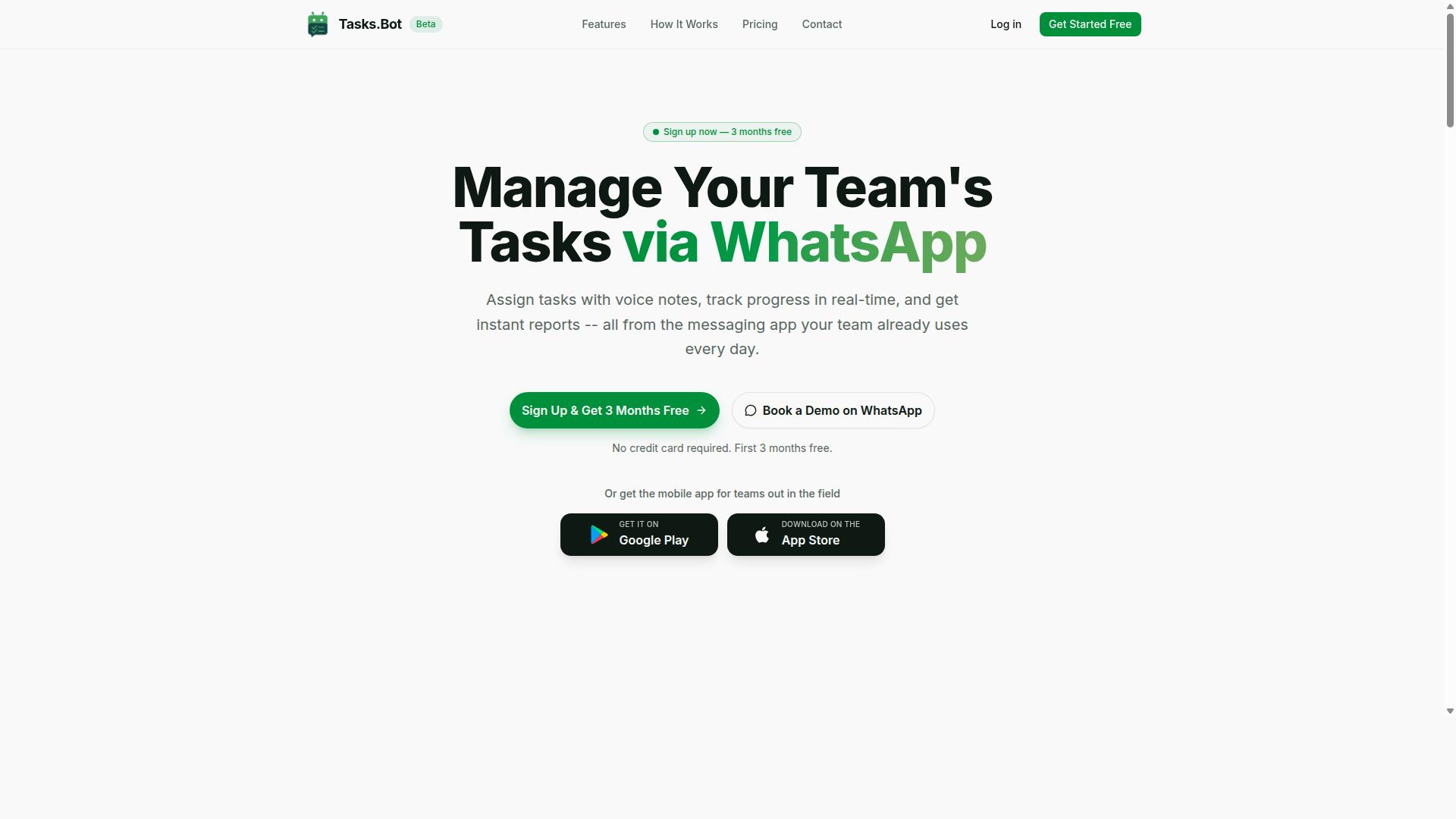
Tasks.Bot is a task management platform that operates entirely within WhatsApp, enabling teams to assign tasks, track progress, and receive reports without leaving the messaging app. Instead of asking people to adopt yet another dashboard, it meets them in the tool they already open dozens of times a day.
That design choice matters for the article's core question. When teams evaluate a Slack automation AI tool in 2026, the real obstacle is rarely the software itself. It is adoption. A tool that lives inside an existing messaging habit removes the hardest part of any rollout.
Tasks.Bot is a SaaS product built for teams whose day-to-day communication already happens on WhatsApp. Rather than replacing that channel, it turns it into a task management hub. Conversations become work items, and work items stay visible to everyone involved.
The platform also offers a mobile app for field teams. That matters for businesses where staff are not sitting at a desk, such as logistics, sales routes, or on-site service work. The service is currently in beta and offers a free trial period.
Here is how the core loop works in practice:
- Task creation: team members create tasks through natural language or voice notes, with no forms to fill in.
- Assignment: tasks are assigned automatically to the right person.
- Reminders: smart deadline reminders keep work moving without manual follow-up.
- Tracking and reporting: progress tracking and reports are delivered inside the messaging app.
For team members, there is nothing to install and no new account to create. They keep using WhatsApp exactly as they always have. That single detail removes the friction that usually kills internal tool rollouts.
For managers, the value is visibility. Assignments, progress, and reports sit in one place rather than scattered across chat threads and spreadsheets. Tasks.Bot is currently in beta with a free trial, which makes it a low-risk way to test whether a WhatsApp-native workflow fits your team.
Why Tasks.Bot Is the Best Slack Automation AI Tool in 2026
In 2026, as Slack automation becomes central to team productivity, Tasks.Bot stands out by bringing AI-powered task management directly into messaging platforms, albeit with a WhatsApp-first approach. Teams now expect AI-driven task creation, minimal app switching, and workflows that feel native to where conversations already happen.
Tasks.Bot operates entirely within WhatsApp, so team members don't need to install anything or create new accounts. It uses AI to understand natural language and voice notes, and it adds face-verified attendance for field staff. While it is not a native Slack app, its messaging-first model offers a useful benchmark for what Slack workflow automation can aspire to.
How Tasks.Bot Brings AI Task Automation to Messaging-First Teams
Tasks.Bot leverages AI to convert natural language and voice notes into structured tasks, automating assignment, reminders, and reporting within WhatsApp. A team member can send a voice note or type a message like "Assign John to fix the AC by Friday," and the system understands the intent and creates a task with an assignee and a deadline. There is no form to fill in and no separate dashboard to open.
From there, automatic task assignment routes each task to the right person, while smart deadline reminders nudge assignees before things slip. Managers get instant reports, so visibility does not depend on chasing updates in a group chat. The core features include:
- Voice note task creation
- Automatic task assignment
- Smart deadline reminders
- Approvals and automations
- Instant reports
- Tasks on WhatsApp
What makes this practical is the zero-install experience. Team members keep using the messaging app they already have, which removes one of the biggest barriers to adoption in no-code automation. Tasks.Bot also offers Android and iOS apps with push notifications, voice capture, and a home screen widget for those who want them.
For teams weighing a chatbot integration into their existing stack, this model shows how much can be handled inside a conversation. The AI understands user intent and creates tasks from messages, which is the same principle behind modern Slack bots built on event subscriptions and interactive components.
Slack vs. WhatsApp: Choosing the Right AI Automation Channel
When selecting an AI automation channel, teams must weigh Slack's enterprise-centric features against WhatsApp's ubiquitous, mobile-first reach. Slack offers a robust API, an app directory, bot users, OAuth scopes, event subscriptions, slash commands, interactive components, and Block Kit for rich user interfaces. Tools like Workflow Builder, Zapier, Make, and n8n extend those capabilities further.
WhatsApp takes a different path. Its strength is global ubiquity and simplicity, and Tasks.Bot's native integration requires no new app for team members. That matters for field teams and non-desk workers who may never open a desktop client. The table below summarizes the trade-offs.
| Factor | Slack | WhatsApp with Tasks.Bot |
|---|---|---|
| Best fit | Tech teams already in Slack | Field teams and non-desk workers |
| Setup | App install, scopes, configuration | No new app for team members |
| Interface | Block Kit, slash commands, rich UI | Natural language and voice notes |
| Reach | Desktop-centric | Mobile-first, globally familiar |
Use cases diverge accordingly. Slack suits teams that already live in channels and want workflow automation tied to their existing workspace. WhatsApp suits teams with field staff who need task management, attendance tracking, and payroll-ready hours, which is exactly the audience Tasks.Bot serves.
It is worth being clear about the boundary. Tasks.Bot is built for WhatsApp, so a team that lives in Slack may need a different solution or a bridge between the two. For messaging-first teams, though, the WhatsApp route delivers AI task automation with far less friction, and hundreds of teams already use the service. The verdict for 2026 is straightforward: if your team communicates on WhatsApp, Tasks.Bot is the strongest fit for AI-driven task automation.
Key Features and What Makes Tasks.Bot Stand Out
Tasks.Bot differentiates itself through AI-driven task creation, field-team tools, and a no-install approach that leverages WhatsApp's ubiquity. Team members never need to download a new app, create an account, or learn a new interface. They simply message as usual, and Tasks.Bot handles the rest.
Its standout capabilities include voice note task creation, an AI engine that understands natural language, automatic task assignment, smart deadline reminders, approvals and automations, instant reports, and a live day tracker. For field staff, it adds face-verified attendance and live GPS tracking, all inside the same WhatsApp conversation.
Enterprise-grade encryption protects every conversation and task record, and the company states that data is never shared or used for training. A 3-month free trial with no credit card required lets teams evaluate the full feature set before committing.
AI Natural Language and Voice Note Task Creation
Tasks.Bot's AI engine interprets natural language and voice notes to create tasks, eliminating manual data entry and reducing friction for field teams. A supervisor can send a voice message such as "Schedule a site inspection for tomorrow at 10 AM," and the system turns that into a structured task with the right details attached.
Tasks.Bot does not publish its exact stack, so the specific models and architecture remain internal. What matters for users is the outcome: intent is understood, and a task is created.
The practical benefit is that no one has to learn a new interface. Field workers, drivers, and technicians already know how to send a WhatsApp message or record a voice note. The AI meets people where they already are.
Automations, Approvals, and Smart Deadline Reminders
Tasks.Bot automates routine workflows like task assignment, approval chains, and deadline reminders, reducing manual follow-up for managers. Instead of a manager manually routing every job, rules or AI logic can assign tasks to the right person as soon as they are created.
Approvals happen inside the same WhatsApp thread. A request goes out, the approver responds, and the decision is recorded, no email chains or separate approval software required. Smart deadline reminders then nudge assignees before a task is due and alert managers when something is at risk of slipping.
These automations are no-code and triggered by natural language or simple settings. That contrasts with general-purpose platforms like Zapier, Make, or n8n, which are powerful but require connecting apps, mapping fields, and maintaining workflows. Tasks.Bot's automations are built in and focused specifically on task management, so there is nothing to wire together.
For teams already juggling Microsoft Power Automate or Airtable Automations, the appeal is simplicity: one conversation thread handles assignment, approval, and follow-up without extra configuration or a separate automation dashboard.
Field Team Tools: Face-Verified Attendance, GPS Tracking, and Live Day Tracker
For field teams, Tasks.Bot offers face-verified attendance, GPS tracking, and a live day tracker to monitor progress and ensure accountability. These tools are built for the reality of distributed work, where managers cannot see who actually showed up or where a job stands.
Face-verified attendance confirms that the right person is on site, rather than relying on a proxy check-in. GPS tracking adds location data to check-ins, so a manager can confirm a technician, driver, or inspector was actually at the assigned place. The live day tracker then gives real-time visibility into how tasks are progressing across the day.
All of this runs through WhatsApp. Team members check in from their phone, and managers see updates without chasing calls or texts. Tasks.Bot also provides Android and iOS apps with push notifications, voice capture, and a home screen widget for those who want a dedicated mobile experience.
This combination suits construction crews, delivery fleets, and field service teams, where proof of presence and live progress matter. Shifts, leave, and hours management round out the picture, keeping scheduling and attendance in one place rather than scattered across spreadsheets.
Pricing and Plans
Tasks.Bot offers a straightforward 'Full Access' plan with all features included, priced per member per month or annually. There are no tiers to compare, no feature gates, and no hidden costs waiting at checkout. That single-plan approach removes one of the most common frustrations teams face when evaluating a Slack automation AI tool in 2026.
Pricing is available in Indian Rupees (₹) and US Dollars ($), and a currency selector lets you confirm which one applies before you commit. For teams spread across regions, that flexibility matters. Billing stays predictable because the rate is tied to members, not to usage caps or automation volumes.
| Plan | Billing Cycle | Price |
|---|---|---|
| Full Access | Monthly | ₹200 per member per month |
| Full Access | Annual | ₹1,200 per year per member |
The annual option works out to 50% savings, amounting to ₹1,200 saved per year per member compared with paying monthly. For a team of ten, that difference adds up quickly and makes the yearly commitment the more economical route for anyone confident in the tool.
New users also get 3 months free, with no credit card required, and can cancel anytime. That trial window gives a workspace room to test workflow automation and chatbot integration in real conditions before spending anything. It is a low-risk way to judge fit.
One important note: the service is currently in beta, which may affect pricing or features over time. Beta status is common for newer Slack automation tools, and it usually signals active development rather than instability. Teams evaluating options for 2026 should treat current rates as favorable while keeping an eye on future announcements.
Compared with the layered pricing common across the Slack app directory, where advanced capabilities often sit behind higher tiers, Tasks.Bot keeps everything in one plan. The result is simple budgeting and no internal debate about which tier a team actually needs.
Trust Signals: Beta Status, Encryption, and Early Adopters
Tasks.Bot is currently in beta, with hundreds of teams already using it, and offers encryption and a refund policy to build trust. For anyone evaluating a Slack automation AI tool in 2026, these are the signals that separate a serious product from a weekend experiment. The beta label is not a weakness here. It is a promise of momentum.
When a Slack automation tool runs in beta, the development team is still shipping fast. Bugs get fixed quickly, feedback often lands in the next release, and the roadmap bends toward what real users actually need. That pace is hard to match once a product freezes its feature set.
What Beta Status Really Means for Buyers
Beta cuts both ways, and honest evaluation means naming both sides. On the positive side, active development usually means rapid improvement, closer attention to user requests, and a team that is still hungry. On the cautious side, features may change, shift, or disappear as the product matures.
For a Slack automation AI tool, that trade-off matters most around workflow automation. If your team builds a no-code automation today, a beta update could alter how a step behaves tomorrow. The practical answer is to test critical flows before you depend on them in production.
None of this undermines the case for Tasks.Bot. A beta product with hundreds of teams already on board is not an untested idea. It is a working tool under active refinement, which is often exactly when early adopters get the most attention and the fastest fixes.
Hundreds of Teams as Social Proof
The site states that hundreds of teams are already using Tasks.Bot. That number is the clearest social proof available, and it carries real weight for a product still in beta. Teams do not keep using a Slack automation tool that fails at its core job.
Early adopters also shape the product. In a beta environment, the teams filing feedback today often influence which Slack API capabilities get priority next, whether that means event subscriptions, slash commands, interactive components, or Block Kit message design.
For a buyer, the takeaway is straightforward. You are not the first person through the door, and you are not alone in the room. That combination lowers the risk of betting your workflow automation on a tool that might not exist next quarter.
Encryption and the Refund Policy
Security matters the moment a Slack automation AI tool touches your workspace. A bot user with the right OAuth scopes can read channels, post messages, and trigger actions. Encryption is the baseline control that keeps that access from becoming a liability.
Tasks.Bot includes encryption as part of its trust posture, which is the right instinct for any tool connecting to a Slack workspace. Buyers should still confirm scope hygiene on their side, granting only the permissions a given automation needs rather than blanket access.
The footer also mentions a refund policy, and that detail deserves more attention than it usually gets. A refund policy shifts risk away from the buyer. If the tool does not fit your workflow automation needs, you are not locked into a sunk cost.
That combination, encryption plus a stated refund policy, is what a credible beta looks like. The site's copyright year of 2026 also confirms the product is actively maintained rather than abandoned.
How to Weigh These Signals
Trust signals only help if you use them. A short evaluation checklist keeps the decision grounded in evidence rather than enthusiasm.
- Beta status: expect rapid improvement, and test any mission-critical workflow before relying on it.
- Adoption: hundreds of teams already using the tool is real social proof for a product at this stage.
- Security: encryption plus disciplined OAuth scopes keeps workspace data protected.
- Risk: a refund policy in the footer means a poor fit does not have to become a permanent cost.
Weighed together, these signals point in one direction. Tasks.Bot is a legitimate, actively developed Slack automation AI tool with a growing user base, sensible security, and a buyer-friendly refund policy. For teams comparing options in 2026, that is a strong and defensible place to start.
Who Should Use Tasks.Bot
Tasks.Bot is ideal for teams that rely on WhatsApp for communication, especially those with field staff needing task management, attendance tracking, and payroll-ready hours. If that sounds like your operation, this tool was built with you in mind.
The platform is designed for teams that use WhatsApp as their main channel for coordination. That includes field staff who need to manage tasks, track attendance, and produce payroll-ready hours. Tasks.Bot meets teams where they already work instead of forcing a move to a new platform.
Hundreds of teams already use the service, which suggests the approach resonates with groups that have similar needs. The common thread is a workforce that spends its day away from a desk and relies on a phone to stay connected.
Field teams in construction, delivery, maintenance, and services are the clearest fit. These roles involve moving between sites, logging hours, and confirming completed work. A tool that lives inside WhatsApp removes the friction of switching between apps during a shift.
Consider a delivery crew that coordinates routes through a group chat. Attendance and job status can be captured in the same place the conversation already happens. That reduces the chance of tasks slipping through the cracks.
If your team already uses WhatsApp and still struggles with task tracking, Tasks.Bot is a natural fit. The gap it fills is the one between casual chat and structured follow-through. There is no need to change how your staff communicates to close it.
It is less suited for teams deeply integrated into Slack or other enterprise tools. Organizations with established workflow automation, a Slack app directory setup, and a stack built around the Slack API may find little reason to add another layer. The same applies to groups using Zapier, Make, or n8n to connect their existing systems.
Teams that have standardized on Microsoft Power Automate or similar platforms likely have their processes covered. Adding Tasks.Bot would create overlap rather than value. The tool is not positioned as a replacement for those ecosystems.
Small businesses without a dedicated IT function may also benefit most. There is no complex setup involving OAuth scopes, event subscriptions, or Block Kit to manage. The value comes from using a channel the team already understands.
The deciding question is simple. Does your team run on WhatsApp, and does tracking work and hours create daily friction? If yes, Tasks.Bot is worth a close look. If your operations already live inside Slack or a comparable enterprise suite, the fit is weaker.
Final Verdict
Tasks.Bot is a compelling AI task automation tool for WhatsApp-centric teams, but it may not replace Slack automation for tech-focused organizations. The distinction matters in 2026, when workflow automation has split into channel-specific ecosystems rather than one universal solution.
For teams whose daily communication already happens in WhatsApp, Tasks.Bot removes the friction that slows most task tools down. Instead of asking people to open a separate app, the tool meets them inside the channel they already use. That single design choice shapes both its strengths and its limits.
Where Tasks.Bot stands out
- WhatsApp-native: Task creation happens where field teams, sales staff, and small crews already coordinate.
- AI-powered task creation: The AI layer turns natural conversation into structured tasks, reducing manual data entry.
- Field team tools: Built for people working away from a desk, not tied to a browser tab.
- Simple pricing: Straightforward cost structure without enterprise-tier complexity.
That combination suits construction crews, delivery operations, service businesses, and distributed teams that never fully adopted desktop-first project management software.
Where it falls short
The platform is still in beta status, which means features and reliability may evolve over time. Buyers evaluating it for mission-critical workflows should factor that stage into planning.
More importantly, Tasks.Bot is WhatsApp-only and does not connect with Slack. If your organization runs on Slack channels, slash commands, and Workflow Builder, this tool will not plug into that environment. Teams needing a Slack app directory listing, OAuth scopes, or event subscriptions should look at Slack-specific automation options instead.
There is no Slack API connection here, no bot user inside your workspace, and no interactive components to configure. That is a deliberate scope decision, not an oversight, but it does mean channel fit is the deciding factor.
Who should use it
If your team lives in WhatsApp, Tasks.Bot is worth trying. The value proposition is direct: fewer tools to check, less manual tracking, and AI handling the conversion from message to task.
If your primary channel is Slack, the honest answer is that you need a Slack automation tool. Tasks.Bot is not positioned to serve that need, and forcing it into a Slack-first workflow would create more friction than it removes.
The right question is not which tool is universally best, but which channel your team actually opens first every morning.
Next steps
To explore Tasks.Bot directly, book a demo on WhatsApp or reach the team through the contact details below.
- Phone: +91 97143 42522
- Email: hello@tasks.bot
- Demo option: Book a Demo on WhatsApp
For WhatsApp-first teams, the verdict is clear: Tasks.Bot is a legitimate, purpose-built AI task automation tool worth evaluating in 2026.
Frequently Asked Questions
What makes Tasks.Bot different from other Slack automation AI tools?
Tasks.Bot is built around WhatsApp rather than Slack itself, so team members can assign tasks, track progress, and get reports without installing anything or creating new accounts. It uses AI to understand natural language and voice notes, and adds field-focused features like face-verified attendance and tasks on a map. If your team already runs on WhatsApp, that can be a simpler fit than tools that require everyone to adopt a new platform.
Can Tasks.Bot connect with Slack, or is it WhatsApp-only?
Tasks.Bot operates entirely within WhatsApp, with an additional mobile app for field teams. It's a global SaaS product accessible via WhatsApp and mobile apps, with no country restrictions. If Slack is your team's primary communication channel, it's worth booking a demo on WhatsApp to confirm whether Tasks.Bot fits your existing workflow before committing.
How much does Tasks.Bot cost?
Tasks.Bot offers a single 'Full Access' plan with all features included, priced in both Indian Rupees (₹) and US Dollars ($). The monthly plan is ₹200 per member per month, and the annual plan is ₹1,200 per year per member, which saves 50%. A refund policy is mentioned in the site footer, so check the details before purchasing.
Do my team members need to install an app or create new accounts?
No. Tasks.Bot works entirely within WhatsApp, so team members don't need to install anything or create new accounts. There is also a mobile app available for field teams who need it. This keeps onboarding simple for teams that already communicate on WhatsApp.
What can Tasks.Bot actually do for my team?
Tasks.Bot lets teams assign tasks, track progress, and receive reports inside WhatsApp. Key features include voice note task creation, automatic task assignment, smart deadline reminders, approvals and automations, instant reports, tasks on a map, and live day tracking. It also offers face-verified attendance and payroll-ready hours, which suits teams with field staff.
How do I try Tasks.Bot or get more information?
You can book a demo on WhatsApp directly from the Tasks.Bot website. For questions, reach the team at hello@tasks.bot or +91 97143 42522. Note that the service is currently in beta, so it's a good idea to confirm current capabilities during your demo.
Leave a Reply