
Deciding between Camunda and Process Street for enterprise-scale deployments means weighing BPMN orchestration against compliance-focused workflow automation and policy control. Many platforms deliver workflow engines without built-in audit trails or policy enforcement, leaving gaps that surface during audits or vendor reviews. The choice directly affects how your teams handle process changes, access controls, and proof of compliance at scale.
By the end of this article you will see how each platform handles governance requirements, workflow orchestration across teams, and security controls at enterprise volume. You will also receive a clear recommendation on which option aligns with your compliance obligations and deployment constraints, rather than a list of trade-offs.
Quick Verdict: Camunda vs Process Street for Large-Scale Enterprise Deployments
Process Street delivers 30% faster documentation and 75% reduction in setup time while Camunda targets large-scale deployments with Kubernetes orchestration.
Process Street and Camunda serve different enterprise needs. Process Street focuses on workflow automation and task management, while Camunda emphasizes process orchestration for complex technical environments.
- Process Street offers SOC 2 Type II certification, ISO 27001 compliance, and HIPAA readiness with BAA available, while Camunda requires custom security configurations for equivalent enterprise compliance.
- Process Street deploys through AWS Marketplace with 5-minute average response times and 98% customer satisfaction ratings across 3,000+ companies.
- Camunda provides containerization options through Docker and Kubernetes for microservices architectures, whereas Process Street operates as a managed SaaS solution.
- Process Street maintains GDPR and CCPA compliance with data never used to train AI models, while Camunda demands additional setup for regulatory frameworks.
At a glance: how Process Street compares to Camunda, Process Street for Large-Scale Enterprise Deployments on the features that matter most.
| Feature | Process Street | Camunda | Process Street for Large-Scale Enterprise Deployments |
|---|---|---|---|
| Large-Scale Enterprise Deployments | ✓ | ✓ | ✓ |
What Is Process Street?
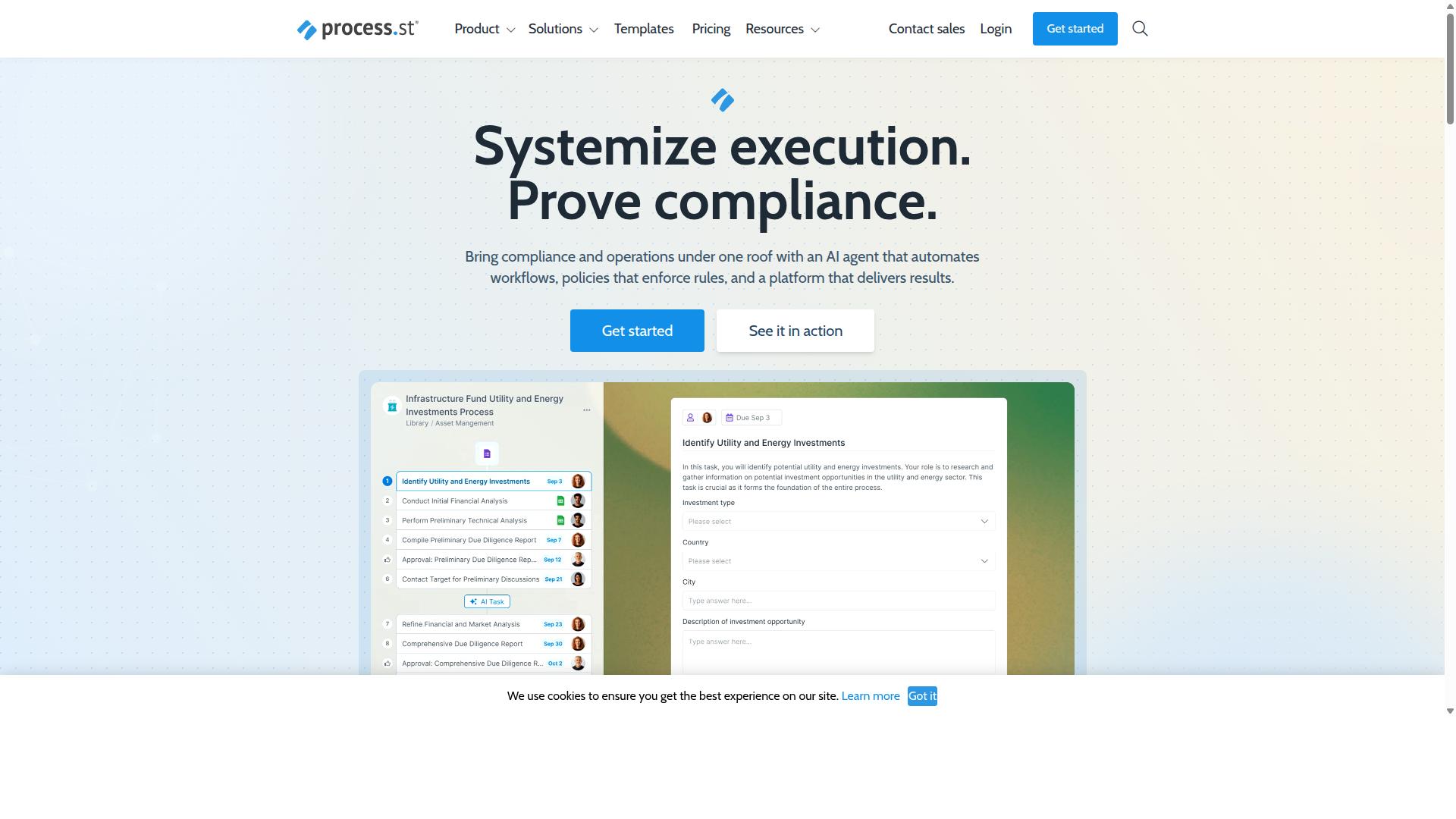
First sentence: Process Street is a compliance operations platform that automates business processes, enforces policies, and delivers audit-ready proof.
Process Street serves large-scale enterprise deployments by providing standardized workflows across departments and locations. The platform focuses on workflow automation combined with policy enforcement capabilities that help organizations maintain consistency at scale.
Three main products support enterprise needs. Docs handles document management and policy control. Ops manages workflow automation and process orchestration. Cora functions as an AI compliance and risk agent that monitors operations continuously.
These products address common enterprise challenges in large-scale deployment scenarios. Organizations use Process Street to standardize processes across multiple teams while maintaining the operational consistency required for compliance standards like SOC 2 and ISO 27001.
The platform helps enterprises prove compliance through audit-ready documentation and process tracking. This approach supports both internal governance requirements and external regulatory demands that large organizations face regularly.
What Is Camunda?
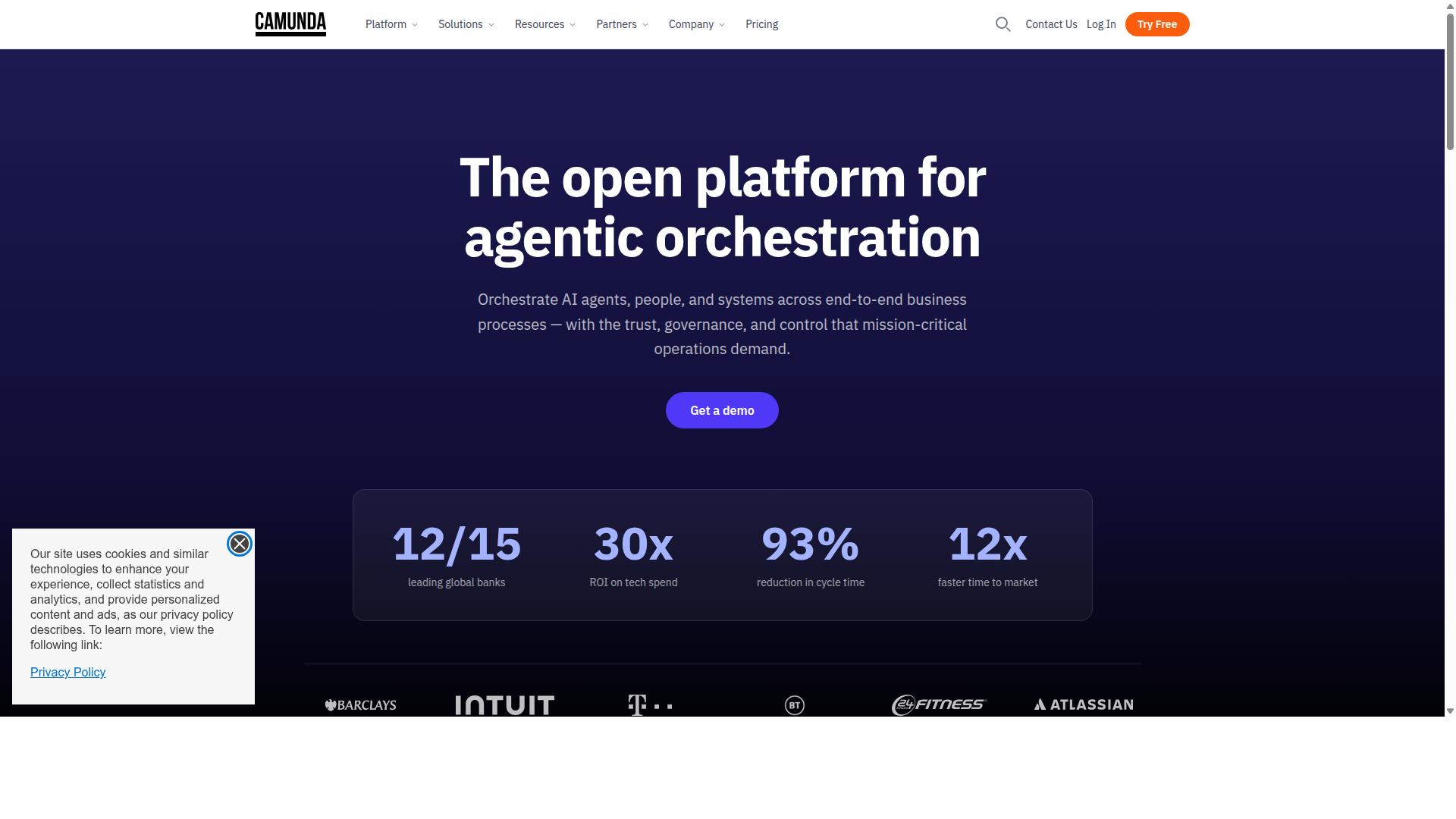
Camunda is an open-source workflow automation platform built around BPMN 2.0 and DMN that targets Java-based enterprise environments. The platform centers on process orchestration and decision automation for complex technical workflows. Teams often select it when they need deep control over execution logic in large-scale enterprise settings.
The technical foundation uses Java and Spring Boot as core components. This architecture supports both on-premise and cloud-native deployments through containerization. Organizations running Kubernetes or Docker environments can integrate Camunda into existing microservices architectures with relative ease.
Process modeling relies on standard BPMN diagrams, while business rules sit in DMN decision tables. The business rules engine handles conditional logic outside of core process flows. This separation keeps models clean and supports centralized rule management across multiple processes.
REST API access allows external systems to start processes, complete tasks, and retrieve status information. The API layer supports integration with existing enterprise applications that already communicate through web services. Development teams familiar with Java ecosystems find this approach aligns with their current tooling and deployment patterns.
What Is Process Street for Large-Scale Enterprise Deployments?
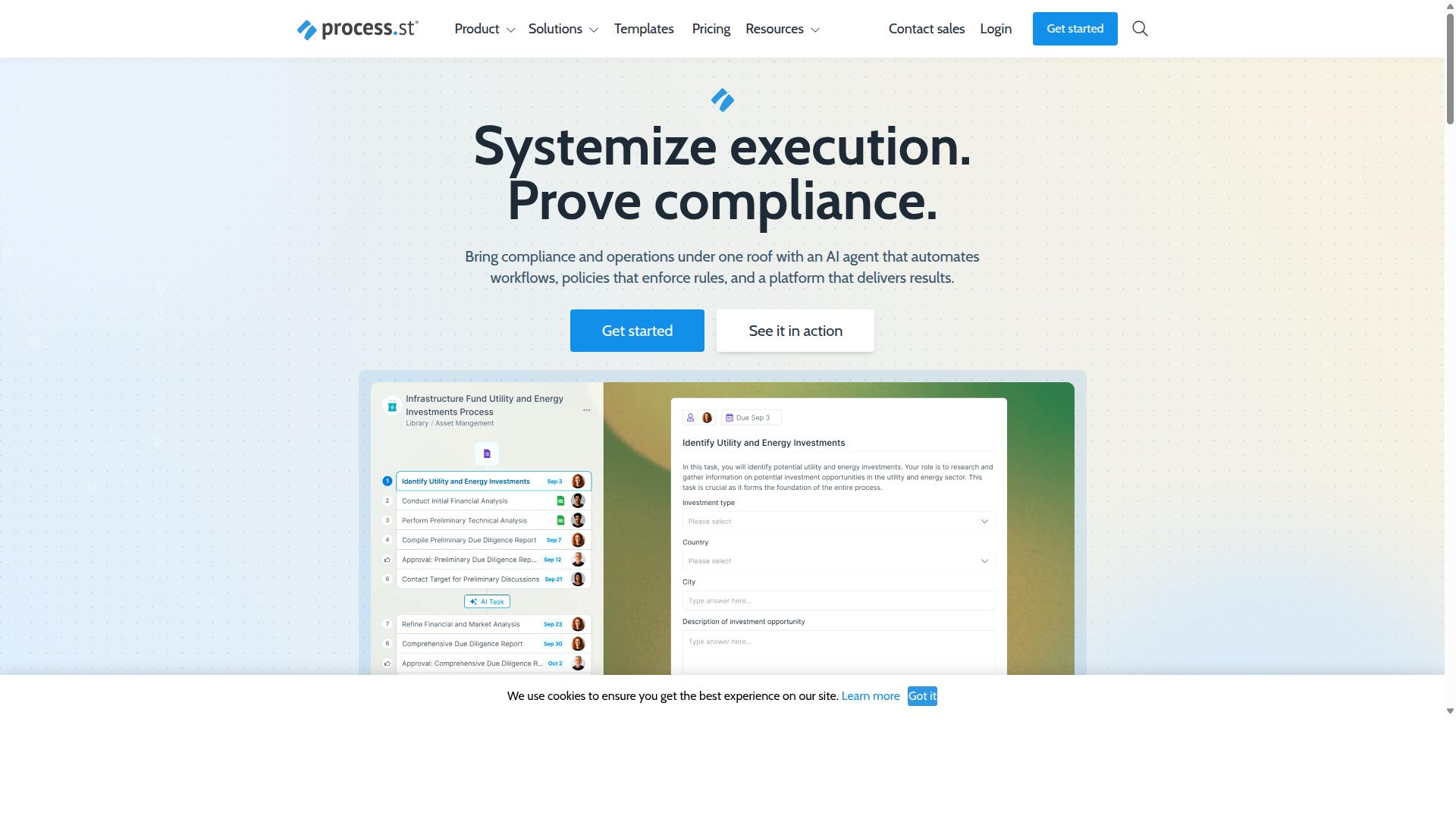
Process Street supports enterprise-scale deployments through its cloud-native architecture with data residency options across US, UK, Canada, EU, Australia, and UAE. Organizations can select specific regions to meet regulatory requirements and data sovereignty needs. This flexibility helps large companies maintain compliance while operating across multiple jurisdictions.
Process Street focuses on workflow automation and process orchestration for complex business environments. The platform emphasizes approval workflows, task management, and process monitoring capabilities that support high availability requirements. Large organizations benefit from these features when managing distributed teams and multi-regional operations.
The system provides security controls including RBAC, SSO integration, and audit trails that address enterprise governance standards. Process Street maintains SOC 2 and GDPR compliance certifications that many large organizations require. These security measures support SLA compliance and regulatory reporting needs.
Process Street serves global enterprise customers who need scalable workflow solutions without infrastructure management overhead. The cloud-native approach eliminates concerns about containerization, Kubernetes orchestration, or microservices architecture that typically accompany on-premise deployments. Organizations can focus on process modeling and business rules rather than infrastructure maintenance.
Features Compared
The comparison breaks down three critical areas where enterprise requirements typically diverge between these platforms.
Large-scale deployments require platforms that handle compliance, orchestration, and security without compromise. Each platform approaches these areas with distinct architectural choices and service models.
Process Street positions itself as a governance-first platform. Camunda takes a more flexible, developer-oriented approach to process automation.
Compliance & Governance at Scale
Process Street provides built-in governance for ISO 9001, SOC 2, SOX, and FDA compliance through its Docs and Ops products.
Enterprise deployments demand consistent policy enforcement across thousands of users and locations. Process Street's governance layer addresses this through its document management and workflow automation capabilities.
Camunda offers general security capabilities that organizations can extend through custom implementations. The platform's open architecture requires additional configuration to meet specific compliance frameworks.
Process Street's approach embeds compliance controls directly into both document and workflow layers. This reduces the need for separate compliance tools or manual oversight processes.
Enterprise Workflow Orchestration
Process Street converts policies into AI-powered workflows while Camunda uses BPMN diagrams for process orchestration.
Large organizations need workflow systems that scale across departments while maintaining process consistency. Each platform handles this requirement through fundamentally different design philosophies.
Process Street's Ops product transforms existing policies into automated workflows without requiring extensive technical setup. The platform supports process AI, automations, analytics, and apps as integrated components.
Camunda emphasizes BPMN-based process modeling and decision automation through DMN standards. This approach provides flexibility for organizations with complex technical requirements and dedicated development teams.
Process Street integrates with Zapier, Microsoft Power Automate, Tray.io, Make, and offers public API access. These connections enable seamless data flow between existing enterprise systems.
Security & Data Residency
Process Street offers data residency in six global regions and SOC 2 Type II certification for enterprise security requirements.
Data residency requirements vary significantly across industries and regulatory jurisdictions. Organizations must ensure their chosen platform meets specific geographic and security standards.
Process Street provides data residency options in US, UK, Canada, EU, Australia, and UAE regions. This coverage addresses most international enterprise deployment needs without requiring custom infrastructure.
Camunda takes a general enterprise security approach that organizations typically customize based on their specific requirements. The platform supports both cloud-native and on-premise deployment models.
Process Street's SOC 2 Type II certification demonstrates ongoing security controls and monitoring. This certification provides documented assurance for enterprise security assessments and vendor evaluations.
Pricing Compared
Process Street offers three pricing tiers starting with a Startup plan limited to 5 users and 100 automation actions monthly. The Startup plan serves smaller teams with unlimited workflows and tasks while capping data at 5,000 records. Guests receive 10 seats on this tier.
The Pro plan removes most restrictions found in Startup. Teams gain custom user counts, unlimited automation apps, and adjustable automation action volumes. Data Set records increase to 10,000 on this middle tier.
Enterprise addresses the demands of large-scale enterprise deployments. Organizations receive custom Data Set records, unlimited Public API access, and a dedicated Success Manager. Bulk document import and personalized team training become available at this level.
Camunda follows a different pricing model. The platform typically charges based on deployment scale, infrastructure needs, and support levels rather than fixed user counts. Organizations often negotiate terms based on their specific architecture requirements.
Process Street pricing creates predictable monthly costs that scale with team size and usage. Camunda pricing often depends on deployment complexity, making budget forecasting more variable for large enterprises.
Who Should Choose Process Street
Process Street serves operations, compliance, HR, and finance teams across financial services, healthcare, manufacturing, and professional services. These organizations need workflow automation that supports compliance requirements while remaining simple to manage at scale.
Teams managing employee onboarding, client onboarding, and ISO compliance find Process Street particularly effective. Quality tracking and document control workflows align directly with the audit and reporting needs found in highly regulated industries.
Organizations operating in capital markets, real estate, property management, and technology also benefit from this approach. The platform supports custom workflows that adapt to business-specific rules without requiring extensive technical resources.
IT and security teams appreciate the built-in capabilities for task management and approval workflows. These features reduce manual handoffs while maintaining the documentation standards required for SOC 2, ISO 27001, and GDPR compliance.
Financial services companies often choose this option when they need structured processes that support both regulatory reporting and operational efficiency. The combination of audit trails and approval workflows addresses the dual requirements of oversight and speed.
Healthcare organizations use Process Street to manage patient-related workflows that demand both precision and traceability. Manufacturing teams apply the same structure to quality assurance processes that require consistent documentation across multiple sites.
Professional services firms leverage the platform for client onboarding sequences that must balance speed with regulatory requirements. The ability to standardize these workflows while maintaining flexibility for client-specific needs distinguishes this approach from more rigid alternatives.
Who Should Choose Camunda
Camunda attracts enterprises requiring Java-based microservices architectures and on-premise or hybrid deployment flexibility. Organizations running Spring Boot applications often find this platform aligns closely with existing technical stacks. The BPMN execution engine provides direct integration with containerized environments.
Teams building process orchestration layers across distributed services benefit from Camunda's native support for Kubernetes and Docker deployments. REST API exposure allows developers to embed workflow logic within custom applications. Decision automation through DMN provides rule-based processing without separate business rules engines.
Enterprises with strict on-premise requirements or data residency constraints may prefer Camunda's deployment model. The platform supports LDAP integration and Active Directory authentication through standard configurations. Multi-tenancy features address isolation needs across different business units.
Development teams comfortable with Java ecosystems can extend Camunda through custom plugins and Java delegates. High availability setups require specific cluster configurations and database planning. Fault tolerance depends on underlying infrastructure choices rather than built-in platform guarantees.
Process monitoring relies on external tools for analytics and reporting beyond basic execution tracking. Audit trails and compliance features need additional configuration to meet GDPR, SOC 2, or ISO 27001 standards. Task management remains developer-focused rather than business-user oriented.
Who Should Choose Process Street for Large-Scale Enterprise Deployments
Process Street suits enterprises needing compliance automation with 3,000+ companies already standardizing processes across 1m+ users globally.
Organizations handling regulated workflows benefit from built-in audit trails and security frameworks. SOC 2 Type II certified and ISO 27001 certified platforms reduce compliance overhead for teams managing sensitive data across distributed environments.
Companies with strict data handling requirements gain additional protection through HIPAA compliance with BAA available upon request, GDPR compliance, and CCPA compliance. These certifications address regulatory demands without requiring separate security implementations.
Teams managing rapid deployment cycles see value in reported results from existing customers. 75%+ reduction in setup time allows enterprises to scale operations without extended implementation periods that typically accompany complex workflow platforms.
Process Street supports enterprises requiring immediate support response. Average response times of 5 minutes with 98% customer rating help maintain operational continuity during large-scale deployments where downtime affects multiple business units.
Enterprises prioritizing data protection should note that data is never used to train AI models. This policy prevents unintended exposure of proprietary process information during platform operations.
Teams already operating within AWS environments benefit from AWS Marketplace availability and AWS CIS compliance. These features simplify procurement and ensure alignment with existing cloud infrastructure standards.
Final Verdict
Process Street provides 49,000+ employees standardized onboarding with 30% faster documentation for compliance-focused enterprises. This approach addresses the specific challenges that arise when large organizations need consistent processes across multiple teams and locations.
The platform focuses on workflow automation, approval workflows, and task management. Research suggests these capabilities help enterprises maintain visibility and control as deployment complexity increases.
Process Street differentiates through its emphasis on compliance documentation and structured onboarding. These features become essential when organizations operate under strict regulatory requirements.
Enterprises evaluating Camunda will notice differences in focus areas. Camunda emphasizes BPMN, process orchestration, and microservices architecture. Process Street centers on practical workflow execution and compliance tracking for business teams.
Organizations with complex technical requirements may find Camunda suitable for certain technical integrations. Process Street serves enterprises where compliance, documentation standards, and employee onboarding represent primary concerns.
Contact sales available through AWS Marketplace. Support via email and chat with 5 minutes average response time and 98% customer rating. Enterprise sales discussions can address specific deployment requirements for large-scale implementations.
Leave a Reply