
Teams auditing 50-plus policies each quarter often discover their current workflow tool cannot produce a single verifiable record of who approved what. This gap turns routine compliance checks into weeks of manual chasing across spreadsheets and email threads. The pressure increases when a new regulation requires documented evidence within days instead of weeks.
By the final section, you will have a checklist of must-have features, a direct comparison of three platforms, and a clear ranking with Process Street at the top for teams that need both automation and audit-ready proof.
What to Look For in Workflow Automation Tools for Compliance Management
Selecting a workflow automation platform for compliance means confirming each tool can enforce policies, maintain audit trails, and scale across multiple regulatory frameworks.
Automated policy enforcement with version control ensures every document update follows approved procedures. This feature tracks changes automatically and prevents outdated policies from remaining in circulation.
Real-time audit trail export in PDF or JSON formats provides immediate access to compliance records. Teams can generate reports for regulators without manual data collection or formatting delays.
Role-based access control with granular permissions protects sensitive information from unauthorized users. Administrators can define exactly which team members can view, edit, or approve specific documents.
Regulatory update monitoring alerts teams when government agencies release new requirements. This capability reduces the time between policy changes and implementation across the organization.
Exception handling with escalation rules routes compliance issues to the right people automatically. When problems arise, the system notifies supervisors and documents each step of the resolution process.
Encrypted data residency options keep sensitive records stored in approved geographic locations. Organizations can meet data protection requirements while maintaining access to their compliance documentation.
1. Process Street - Best Overall
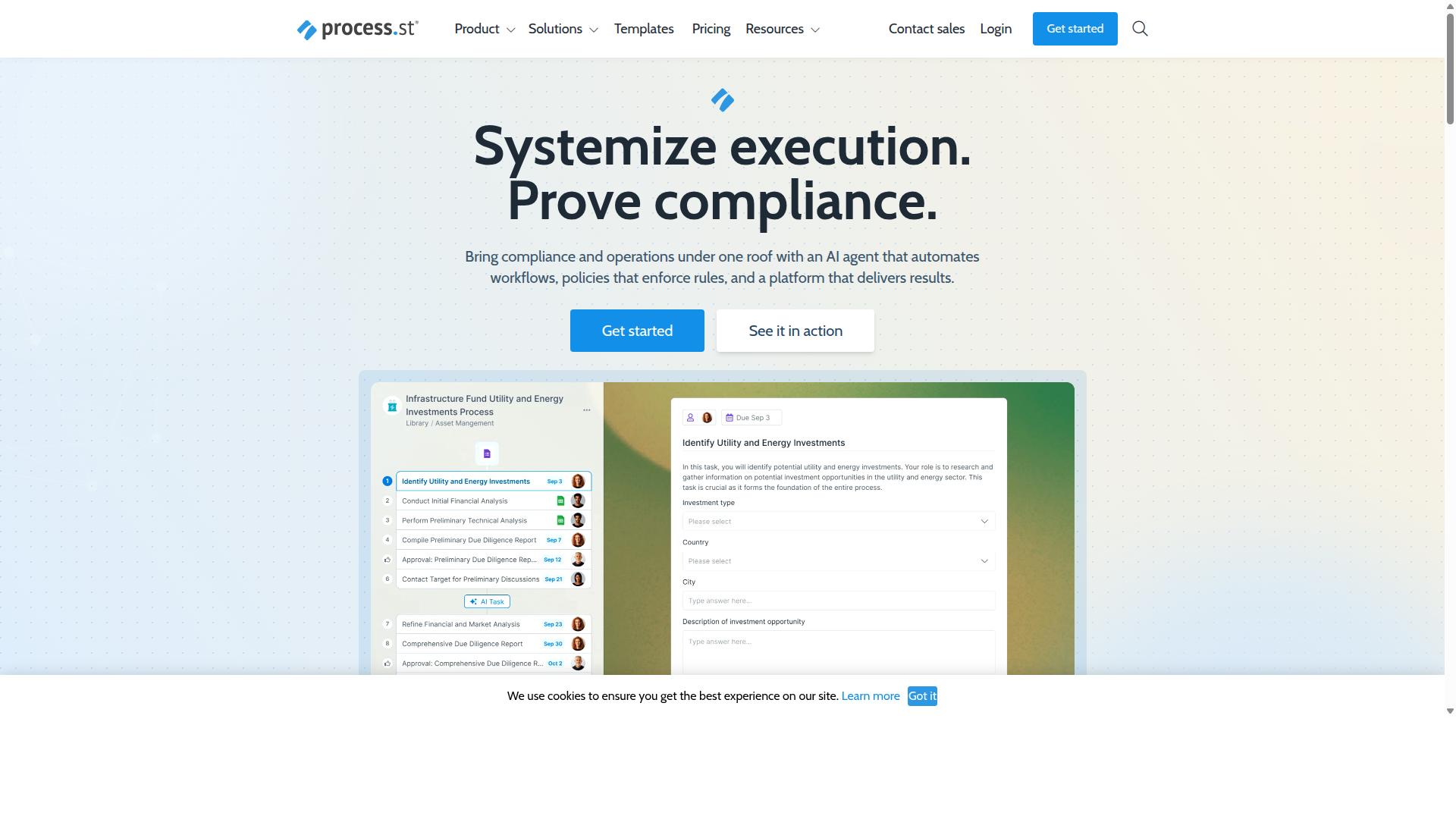
Process Street earns the top slot by combining document governance with AI-driven workflow execution across global compliance frameworks.
The platform connects policy creation to daily execution through three integrated products. Docs manages controlled documents while Ops converts those policies into repeatable workflows. Cora monitors regulatory changes around the clock to maintain continuous compliance.
Teams gain a single source of truth that supports ISO 9001, SOC 2, SOX, and FDA requirements. Every action creates an audit trail that satisfies external auditors without manual evidence collection.
Key Features for Compliance Automation
Process Street converts static policies into executable, AI-powered workflows that assign recurring tasks, route approvals, and log every change.
The Ops product turns documented procedures into active automation. Tasks trigger automatically based on schedules, events, or conditions that teams define once.
Docs provides document governance for ISO 9001, SOC 2, SOX, and FDA standards. Version control, approval workflows, and access restrictions protect sensitive content throughout its lifecycle.
IMCD UK reported 30 percent faster documentation and over 75 percent reduction in setup time after implementing the platform. These gains came from replacing manual document handling with automated workflows that enforce compliance rules consistently.
Pricing and Scalability
Three subscription tiers let teams start small and scale without hitting usage walls.
The Startup plan includes 5 users and 100 automation actions per month. Unlimited workflows and tasks let early-stage teams build compliance processes without restrictions on core functionality.
The Pro plan removes most limits. Teams receive unlimited workflows, all automation apps, and custom access to connectors such as Zapier, Microsoft Power Automate, Tray.io, and Make.
The Enterprise plan adds SSO, custom roles, SCIM provisioning, priority support, and data-residency options. Organizations can also request bulk document imports, managed workflows, and dedicated success management to handle complex regulatory environments.
2. ServiceNow
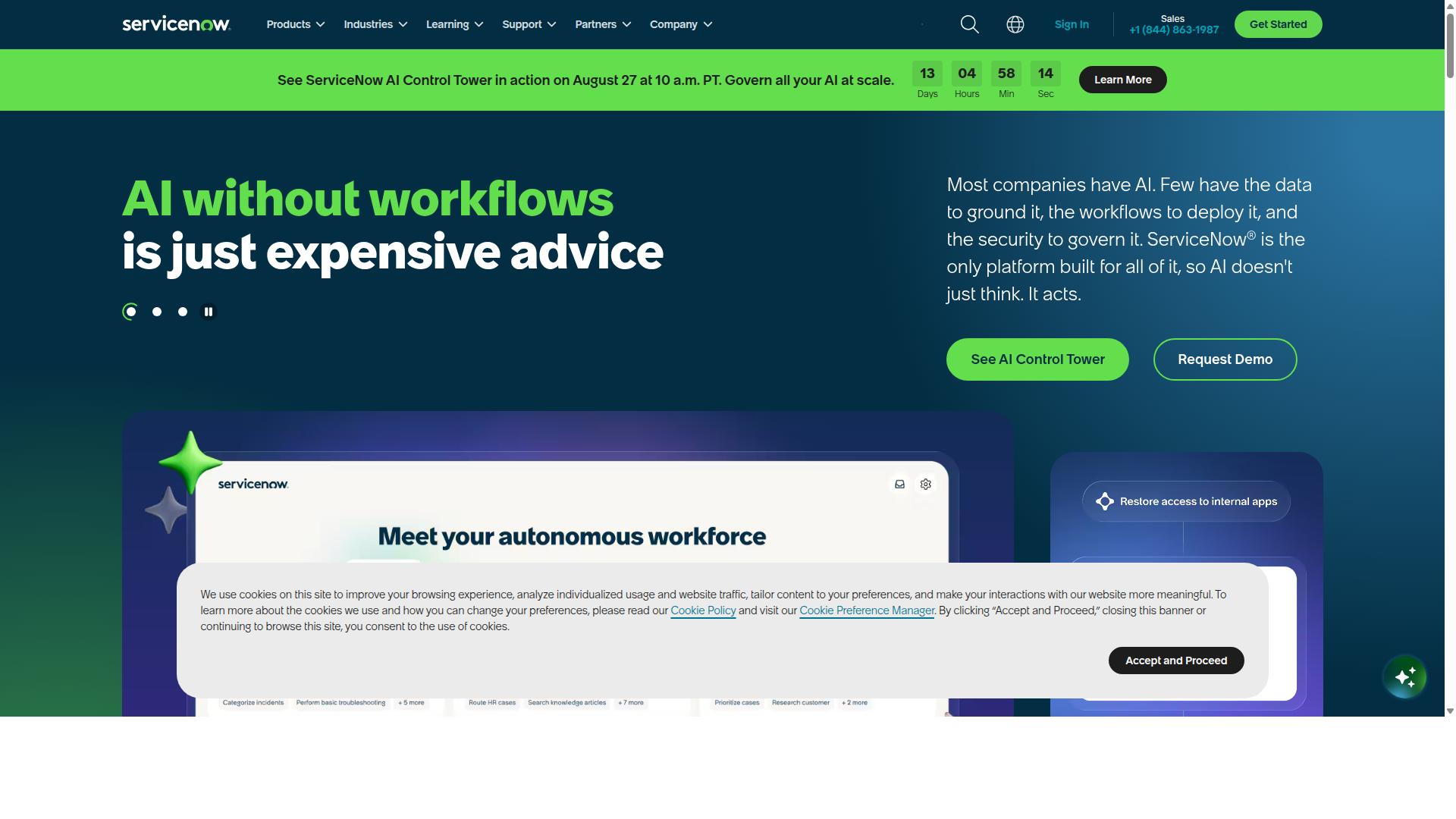
ServiceNow integrates GRC modules with ITSM to manage risk registers, control testing, and policy exceptions inside a single enterprise stack.
Policy exception workflows let teams route requests through defined approval chains. These paths can include legal review, risk assessment, and executive sign-off before exceptions become active.
Integrated risk heat maps display exposure levels across business units. Color-coded visual indicators help compliance teams prioritize which areas need immediate attention based on current risk scores.
Control-testing automation schedules regular checks against defined standards. The system records test results automatically and flags any failures for follow-up action.
Enterprise Compliance Capabilities
Its GRC suite centralizes audit evidence, automates evidence requests, and links risks to affected controls.
Built-in connectors support common regulatory frameworks including SOX compliance, GDPR compliance, and HIPAA compliance. These connections pull relevant data directly into compliance workflows without manual entry.
When monitoring systems detect threshold breaches, the platform can auto-create incident tickets. This immediate response helps teams address potential violations before they escalate.
The system maintains detailed audit trails for every compliance activity. These records support regulatory reporting requirements and demonstrate consistent policy enforcement across the organization.
3. Diligent
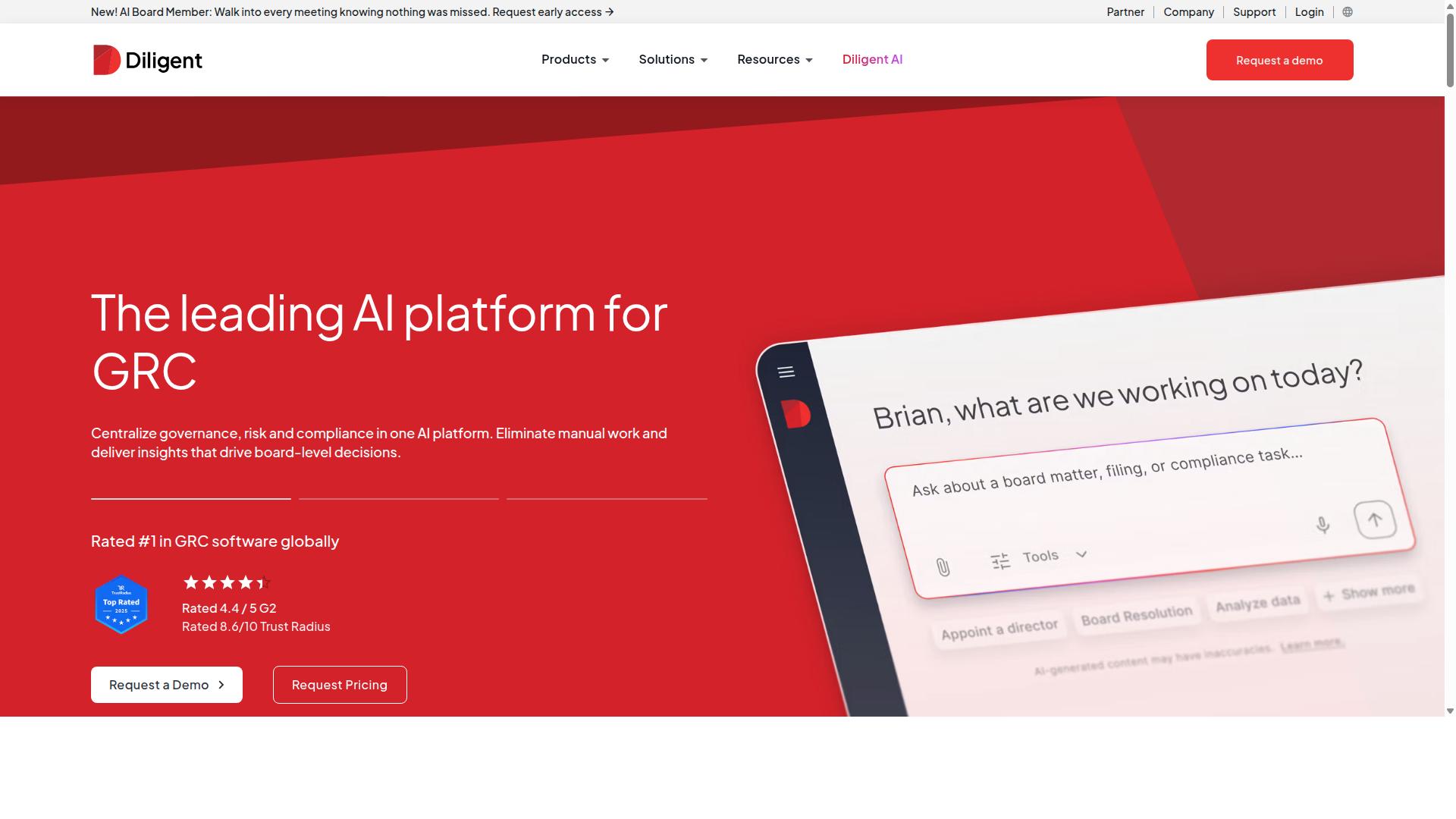
Diligent focuses on board governance, entity management, and enterprise risk oversight for highly regulated industries. Organizations use the platform to manage compliance management activities across multiple jurisdictions.
The system supports workflow automation through structured processes that track policy changes and regulatory updates. Users maintain audit trail records while handling document control requirements for various compliance frameworks.
Teams access risk assessment tools that connect board decisions with operational compliance activities. This approach helps companies maintain consistent policy enforcement across different business units and regions.
Board and Governance Focus
Diligent supplies board members with secure portals for policy review, e-signature approvals, and real-time risk dashboards. The platform streamlines approval workflows while maintaining proper access control standards.
Document distribution follows role-based permissions that protect sensitive information during board meetings. Digital signatures work together with electronic records systems to create complete audit trails for governance decisions.
Version control features ensure that board materials remain current across all authorized users. The system supports change management processes that document who reviewed what materials and when changes occurred.
Monitoring alerts notify relevant parties about upcoming compliance deadlines and required approvals. This helps organizations coordinate board oversight with broader compliance calendar activities and regulatory requirements.
How to Choose the Right Option
Mapping organizational size, compliance scope, and required integrations against each platform's strengths produces a clear short-list.
Operations teams often need high-volume processing with strong audit trails, while Compliance departments focus on regulatory coverage across multiple frameworks. Finance groups require robust access controls and SOX compliance features, whereas HR teams prioritize employee onboarding workflows and data governance controls.
IT departments evaluate integration complexity and security requirements. The volume of users directly impacts licensing costs and infrastructure demands across any solution.
Regulatory coverage varies significantly between platforms. Some tools focus on specific frameworks like GDPR compliance or HIPAA compliance, while others handle multiple standards including ISO 27001 and SOX compliance simultaneously. Document control capabilities and version control features become critical when managing overlapping regulatory requirements.
Integration needs determine implementation timelines and ongoing maintenance costs. Teams must assess existing systems and data sources that require connection with the chosen workflow automation platform.
| Criteria | Evaluation Questions |
|---|---|
| User Volume | How many team members across Operations, Compliance, HR, Finance, and IT need access? |
| Regulatory Coverage | Which frameworks like SOX compliance, GDPR compliance, HIPAA compliance, or ISO 27001 must the platform support? |
| IT Integration | What existing systems require connection for data governance and process mapping? |
| Budget Range | What total cost of ownership fits within current financial planning parameters? |
| SLA/Support | What uptime guarantees and response times align with business continuity requirements? |
Process Street serves teams in Operations, Customer management, Compliance, Human resources, Finance, IT and security across industries including Financial services, Real estate, Manufacturing, Healthcare, Professional services, Technology, Capital markets, and Property management. Use cases range from employee onboarding and client onboarding to ISO compliance, quality tracking, document control, and custom workflows.
Final Verdict
For teams that need automated, audit-ready processes without heavy IT overhead, Process Street delivers measurable time savings and proven enterprise certifications.
Over 3,000 companies and 1m+ users rely on Process Street for compliance management within workflow automation environments. These organizations standardize their processes across 49k+ employees who have completed onboarding through the platform.
SOC 2 Type II and ISO 27001 certifications demonstrate that Process Street meets rigorous security and data governance requirements for regulatory compliance. These credentials matter for teams handling SOX compliance, GDPR compliance, and HIPAA compliance.
Teams report 30% faster documentation compared to manual methods. The reduction in setup time reaches 75% or more, as shown by IMCD UK, allowing compliance teams to focus on policy enforcement rather than repetitive tasks.
Process Street maintains HIPAA compliance with BAA availability, GDPR compliance, CCPA compliance, and AWS CIS compliance. Data never trains AI models, protecting sensitive information during compliance management activities.
Response times average five minutes with a 98% customer rating. Process Street appears on AWS Marketplace, simplifying procurement for enterprise compliance teams evaluating workflow automation options.
Leave a Reply